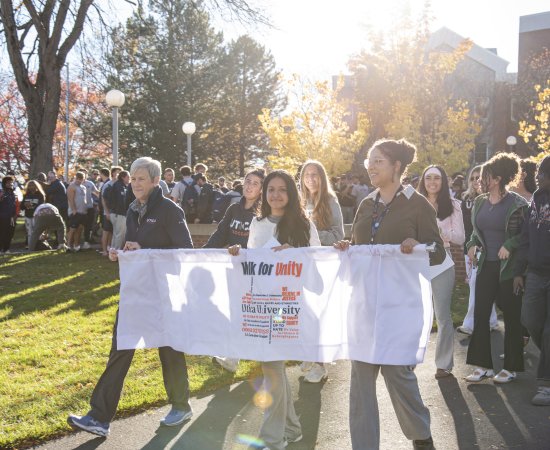
Stronger Together – Unity Walk 2026
Putting feet to pavement amid the golden rays and the autumn colors as rich and multiple as the backgrounds and...


Dunn’s research focuses on silver nanoparticles (Ag NPs), because of those unique chemical and physical properties which makes them useful in biomedicine and nano-technological applications.
Nanoparticles may be smaller than the wavelengths of visible light, but there’s nothing small about the potential applications being researched by chemistry major Kayla Dunn ’26.
As a high school student, Dunn for a long time had her sights set on biology, but it was a college-level chemistry class that changed everything for her.
“After taking General Chemistry 1 as a freshman, I realized that chemistry was my true passion,” says Dunn. “I love being in the lab and getting that hands-on experience.”
After getting her associate's degree at Mohawk Valley Community College, Dunn knew that Utica was her next step.
“I had heard from others that they have an awesome chemistry department and focus on research, which I really wanted to do.”
She began doing research with Dr. Alyssa Thomas in Spring 2026 where she learned all about nanoscience, something she was very interested in.
“I came to love it, too,” she says excitedly. “She allows her students to design their research however they want, which is so awesome. Dr. Thomas, as well as the whole chemistry department, are such supportive professors. They truly will do anything they can to make sure you succeed.”
Going in with a few umbrella projects ready to discuss as she meets with potential research students, Dr. Thomas looks to find what will excite them the most while also aligning with the student’s goals.
“Kayla and I had robust discussions on what reducing agent to choose and ultimately used a procedure she found in an article with a twist I suggested from another article," Dr. Thomas says. "The result was a combination of chemical compounds that had not been studied before in making silver nanoparticles. It is a fairly simple procedure to make nanoparticles, but harder to tune or manipulate them to achieve specific end results.”
Though the research is currently in its beginning stages, it shows promising results. Especially for Dunn, a transfer student, this research project helps to cement her role in the program and integrate her into the chemistry department.
“It is exciting to see students work hard on something they are unsure about and grow into their own over the semester," says Dr. Thomas. "They gain confidence to ask their own questions and to try their own experiments. What happens if I change this solvent? What if I change the ratio? And to be able to have them try those changes or tweaks to see if they succeed or fail miserably, that is what makes this experience beneficial to students like Kayla.”
Gaining significant attention due to their versatility in applications such as medicine and technology, Dunn’s research into silver nanoparticles hopes to find endless opportunities for their use.
“If you took a meter stick and chopped it into a billion pieces, one piece would be a nanometer,” explains Dr. Thomas. “A human hair is about 80,000 nanometers while a silver atom is 0.29 nanometers. And if we took a bunch of silver atoms and clumped them together, we can make a nanoparticle or a tiny cluster of atoms that functions as a single unit.”
Scientists create silver nanoparticles using a chemical process called reduction. A silver salt (like silver nitrate) is mixed with a reducing agent (like sodium citrate), which causes silver ions to form silver atoms which clump together into tiny nanoparticles. A stabilizing agent is then used to stop them from growing too large.
Silver nanoparticles have different properties than a silver coin. Their properties can be manipulated, tuned, or engineered by changing their size, their shape (spherical vs rods), and material (gold, silver, vs copper).
“If I wanted to change the color of a firework, I have to change the chemical compound (barium salts are green while strontium salts are red), but at the nanometer scale, I can go from green to red by changing the size or shape of silver nanoparticles,” Dr. Thomas explains.
Dunn’s research focuses on silver nanoparticles (Ag NPs), because of those unique chemical and physical properties which makes them useful in biomedicine and nano-technological applications.
“Kayla's research is synthesizing silver nanoparticles for potential biological applications using green chemistry principles. Silver has antimicrobial and antibacterial properties that make it useful in wound healing and bone repair (among other applications),” says Dr. Thomas. “Her project involves choosing reducing agents that are less environmentally hazardous and designing her synthesis for waste prevention.”
Once synthesized, Dunn optically characterizes them using UV-Visible spectroscopy to determine average size, size range, and concentration.
“I was honestly unsure at first of what I wanted to do,” Dunn says. “But I loved the green approach to making nanoparticles, as green science is so important to me.”
Research projects like these often come about during junior and senior years, making their collaborations with mentors like Dr. Thomas come toward the end of their academic careers. But the lasting impact on both mentor and mentee lasts long beyond.
“It has been great to get to know Kayla outside the classroom and how she approaches lab work,” says Dr. Thomas. “She is diligent and had some great ideas for her project after she learned the nanoparticle basics. I have seen her grow more confident in the lab and with research. I cannot wait to see how the fall unfolds as we work towards presenting at the American Chemical Society (ACS) Spring 2027 national meeting in New Orleans.”

For a general list of frequently used logins, you can also visit our logins page.